
Table of Contents
- Why Skid Steer Attachments Are the Real Investment
- The Most Common Skid Steer Attachments (and What Each One Actually Does)
- How to Match Skid Steer Attachments to Your Machine
- New vs. Used Skid Steer Attachments: What's Worth Buying Secondhand
- Where to Find Deals on Skid Steer Attachments, Including Government Surplus Auctions
- What Government Agencies Are Actually Selling Right Now
- Quick Reference: Matching Skid Steer Attachments to Common Jobs
- Final Thoughts: Building a Smart Attachment Strategy
If you're shopping for skid steer attachments, you already understand the basic idea: one compact machine, dozens of possible jobs. But understanding the idea and actually building a smart attachment fleet are two different things. This guide covers both. You'll find a breakdown of every major skid steer attachment category, how to match attachments to your specific machine, which types are worth buying used, and where to find the best deals, including government surplus auctions that most buyers overlook entirely.
Why Skid Steer Attachments Are the Real Investment
The skid steer itself is the platform. The attachments are where the real versatility lives.
A single skid steer frame, maintained well and matched to the right attachments, can handle land clearing in the spring, trenching for utilities in the summer, snow removal all winter, and demolition work in between. For municipalities, that flexibility is the difference between owning eight specialized machines and owning one machine that earns its keep across eight departments.
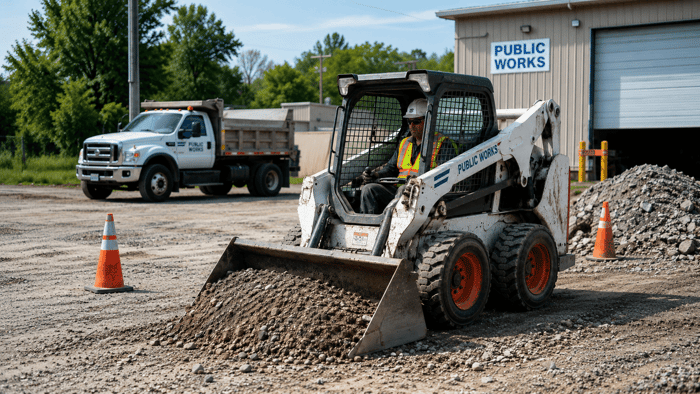
That's not a hypothetical. Public works departments routinely run a single skid steer through seasonal attachment rotations: bucket and forks for general yard work, a snow blower or pusher in winter, a brush cutter for right-of-way maintenance, an auger for sign post installation. The machine stays the same. The job changes.
For contractors and independent operators, the math is similar. Skid steer attachments let you take on work you'd otherwise have to turn down or subcontract. And because attachments are interchangeable across compatible machines, they hold their value in ways that highly specialized equipment often doesn't.
The catch: buying the wrong attachment, whether that's the wrong coupler type, wrong flow rate, or wrong lift capacity, turns a smart investment into an expensive mistake. This guide is built to help you avoid that.
The Most Common Skid Steer Attachments (and What Each One Actually Does)
Here's a category-by-category breakdown of the attachments you'll encounter most often, what they're for, and when they earn their keep.
Buckets
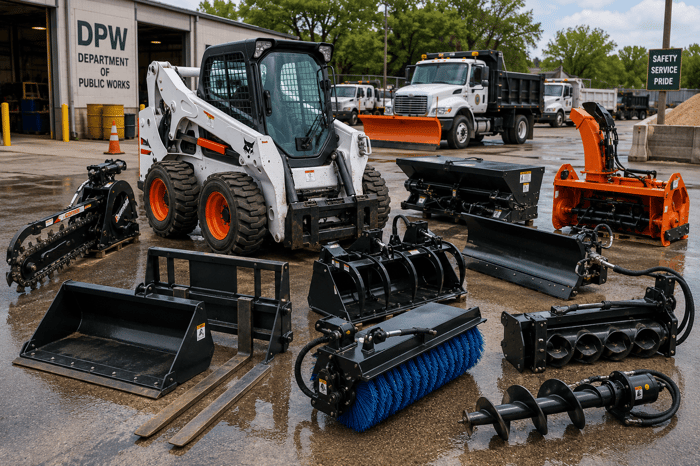
The default attachment for most skid steers, and for good reason. Standard dirt buckets handle excavation, grading, backfill, and material moving. Specialty variants include rock buckets (with tines for sifting), skeleton buckets, and high-capacity buckets for lighter materials like mulch or snow. If you own a skid steer, you almost certainly need at least one bucket.
Pallet Forks
Essential for any operation that moves palletized materials: construction sites, nurseries, warehouses, agricultural operations. Pallet forks are one of the simplest attachments mechanically, which makes them one of the safest to buy used. Tine length and carriage width matter, so match them to the loads you're actually moving.
Augers
Hydraulic augers drill holes for fence posts, sign posts, tree planting, and foundation piers. The auger drive unit mounts to the skid steer; bits are interchangeable by diameter. Augers are hydraulic-driven and require adequate flow from the host machine. More on that in the compatibility section below.
Brush Cutters and Mulchers
Built for vegetation management: clearing overgrown fields, maintaining road rights-of-way, processing light brush and small trees. Municipalities and utility companies use these heavily. They're high-flow attachments, most require 20+ GPM, and they take significant wear. Used units need careful inspection before purchase.
Grapples
Root grapples, rock grapples, and demolition grapples use hydraulic claws to grab, move, and sort irregular material. Contractors use them for debris cleanup, land clearing, and demolition. Grapples are mechanically robust and generally hold up well used, though the hydraulic cylinders and hoses deserve close inspection.
Trenchers
Chain trenchers cut narrow trenches for irrigation lines, electrical conduit, drainage pipe, and utility installation. Depth and chain width vary by model. Trenchers are hydraulic-driven and put significant stress on the host machine's hydraulic system, so matching carefully is important.
Snow Blowers and Snow Pushers
Snow blowers use an auger-and-impeller system to throw snow clear of the path, which is useful where you can't just push it to the side. Snow pushers (box plows) are simpler and faster for large open areas. Both are seasonal skid steer attachments that see heavy use for a few months and then sit. Government surplus is an excellent source for both.
Hydraulic Breakers
Also called hammers, these attachments break up concrete, asphalt, rock, and frozen ground. They're common in demolition and utility work. Breakers require specific hydraulic flow and pressure settings. Running them on a mismatched machine damages both the attachment and the skid steer.
Sweepers
Rotary broom sweepers clear debris, dirt, and loose material from paved surfaces. Municipalities use them constantly on parking lots, roads, and sidewalks. Angle-adjustable models are more versatile. Sweepers are relatively simple mechanically and are good candidates for the used market.
Tillers
Soil tillers break up and condition ground for seeding, landscaping, and agricultural prep. The rotating tines churn soil to a consistent depth. Tillers are hydraulic-driven and see seasonal use. Inspect the tines and gearbox carefully on any used unit.
How to Match Skid Steer Attachments to Your Machine
This is the section most buyers skip. It's also the section that prevents the most expensive mistakes. Three factors determine compatibility: coupler type, hydraulic flow rate, and lift capacity.
Coupler Type
Most modern skid steers use a universal quick-attach plate system (also called Bob-Tach, universal skid steer mount, or ISO 24410). The majority of aftermarket attachments are designed around this standard. The problem: some manufacturers use proprietary coupler systems, and older machines may not be compatible with universal-mount attachments without an adapter plate.
Before you buy any attachment, confirm the coupler type on your machine. If you're buying a used attachment from a different brand than your skid steer, check whether an adapter is available and what it costs. Adapter plates work well but add weight and can affect geometry on some attachments.
Hydraulic Flow Rate
Skid steers fall into two categories: standard flow (typically 15 to 20 GPM) and high flow (typically 25 to 40 GPM). Simple attachments like buckets and forks don't use auxiliary hydraulics at all. Powered attachments, including augers, brush cutters, mulchers, snow blowers, trenchers, and hydraulic breakers, have specific flow requirements.
Running a high-flow attachment on a standard-flow machine means it will underperform or not function at all. Running a low-flow attachment on a high-flow machine at full pressure can damage the attachment. Always check the attachment manufacturer's required GPM range against your machine's rated output before purchasing.
Lift Capacity and Rated Operating Capacity
Every skid steer has a rated operating capacity (ROC): the maximum load it can safely handle at full lift height. A loaded pallet of concrete blocks, a full bucket of wet soil, a heavy grapple load, all of these need to fall within your machine's ROC with a safety margin.
The attachment itself adds weight before you put anything in it. A heavy-duty grapple bucket might weigh 800 pounds empty. Add that to your load weight and compare it to your machine's ROC. This math matters most when you're running attachments at height or on uneven ground.
New vs. Used Skid Steer Attachments: What's Worth Buying Secondhand
Not all attachments carry equal risk on the used market. Here's an honest breakdown by category.
Generally Safe to Buy Used
- Buckets. Simple steel construction, minimal moving parts. Inspect for cracks in the bucket body and at the mounting plate welds, worn or missing cutting edges (replaceable), and bent or cracked side cutters. A bucket in decent structural shape is a good used buy.
- Pallet forks. Check for bent tines (a deal-breaker, since bent tines indicate overloading), cracks at the tine-to-carriage weld, and wear on the carriage hooks. Otherwise straightforward.
- Grapples. Inspect the hydraulic cylinders for leaks, the hoses for cracking or abrasion, and the tines for cracks or significant deformation. The pivot points should move freely without excessive play. Grapples are robust and tend to age well.
- Sweepers. Check the broom core and bristle wear (bristles are replaceable), the drive motor for leaks, and the angle adjustment mechanism. Sweepers are good used candidates.
- Snow pushers. Mostly steel and rubber. Inspect the cutting edge, the trip springs or rubber deflector, and the mounting plate. Simple and durable.
Require More Scrutiny When Buying Used
- Brush cutters and mulchers. Inspect the rotor, flails or fixed blades, and the belt or direct-drive system carefully. These skid steer attachments take heavy abuse. Worn or damaged cutting components are expensive to replace, and a machine that's been run into rocks or stumps repeatedly may have internal damage that isn't visible externally.
- Augers. The drive unit is the expensive part. Check for oil leaks at the motor and gearbox, inspect the mounting hardware, and test the drive unit under load if possible. Bits are consumable and cheap; the drive unit is not.
- Hydraulic breakers. Breakers have internal wear components (chisels, bushings, diaphragms) that degrade with use. A breaker with unknown hours is a risk. Ask for service records. A well-maintained breaker with documented service history is a reasonable used buy.
- Trenchers. Inspect the chain, sprocket, and boom for wear. Chains are consumable but can be expensive. The drive motor and gearbox should be leak-free.
- Snow blowers. The auger and impeller are the key components. Check for blade damage, impeller wear, and shear bolt condition. The hydraulic motor and chute rotation mechanism should operate smoothly.
Why Government Surplus Units Often Stand Out
Government agencies, including municipalities, counties, school districts, and public works departments, are required by law to maintain maintenance records on their equipment. That documentation requirement extends to attachments in many cases. When you buy a surplus skid steer attachment from a government agency, you're more likely to get a paper trail than you would from a private seller or even a dealer trade-in.
Government fleet managers also tend to run equipment conservatively and maintain it on schedule, because they're accountable to the public for how they treat public assets. That's not universal, but it's a meaningful pattern worth knowing about.
Where to Find Deals on Skid Steer Attachments, Including Government Surplus Auctions
The sourcing landscape for used skid steer attachments breaks down into a few main channels, each with its own tradeoffs.
Dealers and Rental Companies
Equipment dealers often sell trade-in attachments alongside new inventory. Rental companies regularly cycle out attachments after a set number of hours. Prices tend to be higher than the private market, but you often get some degree of inspection and sometimes a short warranty. A good option if you want a lower-risk used purchase and are willing to pay a premium for it.
Private Sellers and Classifieds
Craigslist, Facebook Marketplace, and equipment-specific classifieds (MachineryTrader, IronPlanet) all surface private-party attachments. Prices vary widely. Inspection is on you, and documentation is rare. You can find genuine deals here, but you need to know what you're looking at before you bid.
General Auction Platforms
Online auction platforms run liquidation sales for contractors, rental companies, and occasionally government agencies. Lot quality and documentation vary. Read every listing carefully. "As-is, no returns" is the standard condition, and photos may not tell the whole story.
Government Surplus Auctions
This is the channel most attachment buyers haven't fully explored, and it's worth understanding. Municipalities, counties, townships, school districts, and state agencies regularly surplus equipment and attachments as part of their normal budget and fleet management cycles. Those surplus items go to public auction, and the public can bid.
Municibid is a platform built specifically for government surplus auctions. Agencies list surplus items directly; buyers bid online. Because the sellers are government entities, listings tend to include more documentation than you'd get from a private seller, and the auction process is transparent and accountable. You can browse skid steer listings, heavy equipment listings, and landscaping equipment to get a sense of what's currently available.
The key advantage isn't just price. It's information. A municipality listing a surplus snow blower typically knows when it was purchased, how many seasons it ran, and whether it received routine maintenance. That's the kind of context that's hard to get anywhere else.
What Government Agencies Are Actually Selling Right Now
Understanding what shows up in government surplus auctions, and why, helps you shop more strategically for skid steer attachments.
What Comes Up Most Often
The attachments that appear most frequently in public surplus are the ones governments use most: buckets in various sizes, pallet forks, snow blowers and pushers, sweepers, and brush cutters. These are the workhorses of municipal operations, and they get surplused regularly as agencies upgrade to newer equipment or consolidate their fleets.
Augers, grapples, and hydraulic breakers show up less frequently but do appear, particularly from larger public works departments and county road crews that run more specialized operations.
What Drives the Surplus Cycle
Government surplus isn't random. A few predictable patterns drive it:
- Fleet upgrades. When an agency replaces its skid steer with a newer model, the old attachments may not be compatible with the new machine's coupler system or flow requirements. Those attachments get surplused.
- Budget cycles. Many agencies surplus equipment at the end of the fiscal year to free up budget and storage space. Timing your search around these cycles, typically spring and early fall, can pay off.
- Consolidation. When two departments merge or a municipality contracts out a service it used to perform in-house, the equipment that supported that service often goes to auction.
Quick Reference: Matching Skid Steer Attachments to Common Jobs
If you're building out an attachment fleet from scratch, here's a practical starting point based on the most common use cases.
For Municipal Public Works
Start with a standard dirt bucket, pallet forks, and a snow pusher or blower depending on your region. Add a sweeper for road and parking lot maintenance. A brush cutter rounds out the kit for right-of-way work. These five skid steer attachments cover the majority of day-to-day municipal operations.
For Landscaping and Site Prep Contractors
A dirt bucket and pallet forks are the baseline. Add a tiller for soil prep, a grapple for debris and brush cleanup, and an auger for planting and post installation. If you work in areas with heavy vegetation, a mulcher or brush cutter earns its keep quickly.
For Demolition and Utility Contractors
A hydraulic breaker is often the first specialized attachment in this category. Add a grapple for sorting and moving debris, a trencher for utility work, and a bucket for general material moving. These skid steer attachments are the core of most demo and utility attachment fleets.
Final Thoughts: Building a Smart Attachment Strategy
The best attachment strategy isn't about owning everything. It's about owning the right things for the work you actually do, buying smart on the used market where the risk is manageable, and knowing where to look when a good deal comes up.
Government surplus auctions are an underused channel for exactly that. The documentation is better, the sellers are accountable, and the prices reflect fair market value rather than dealer markup. If you haven't browsed what's available, it's worth a look. Skid steer attachments from public agencies show up regularly, and the buyers who know to check are the ones who find the deals.
100% of auction proceeds go back to the communities selling them. That's not a small thing. Every attachment you buy through a government surplus auction puts money back into a public budget, whether that's a road repair fund, a parks department, or a school district's equipment account.