
Table of Contents
- What dump truck rental really costs (daily, weekly, monthly, and the fees nobody mentions)
- What it costs to own a used dump truck beyond the sticker price
- The break-even formula: how many rental days make buying cheaper?
- Three contractor profiles: who should rent, who should buy, who should do both
- Where used dump trucks come from, and why government surplus is worth a look
- How to decide: a five-question checklist before you rent or buy
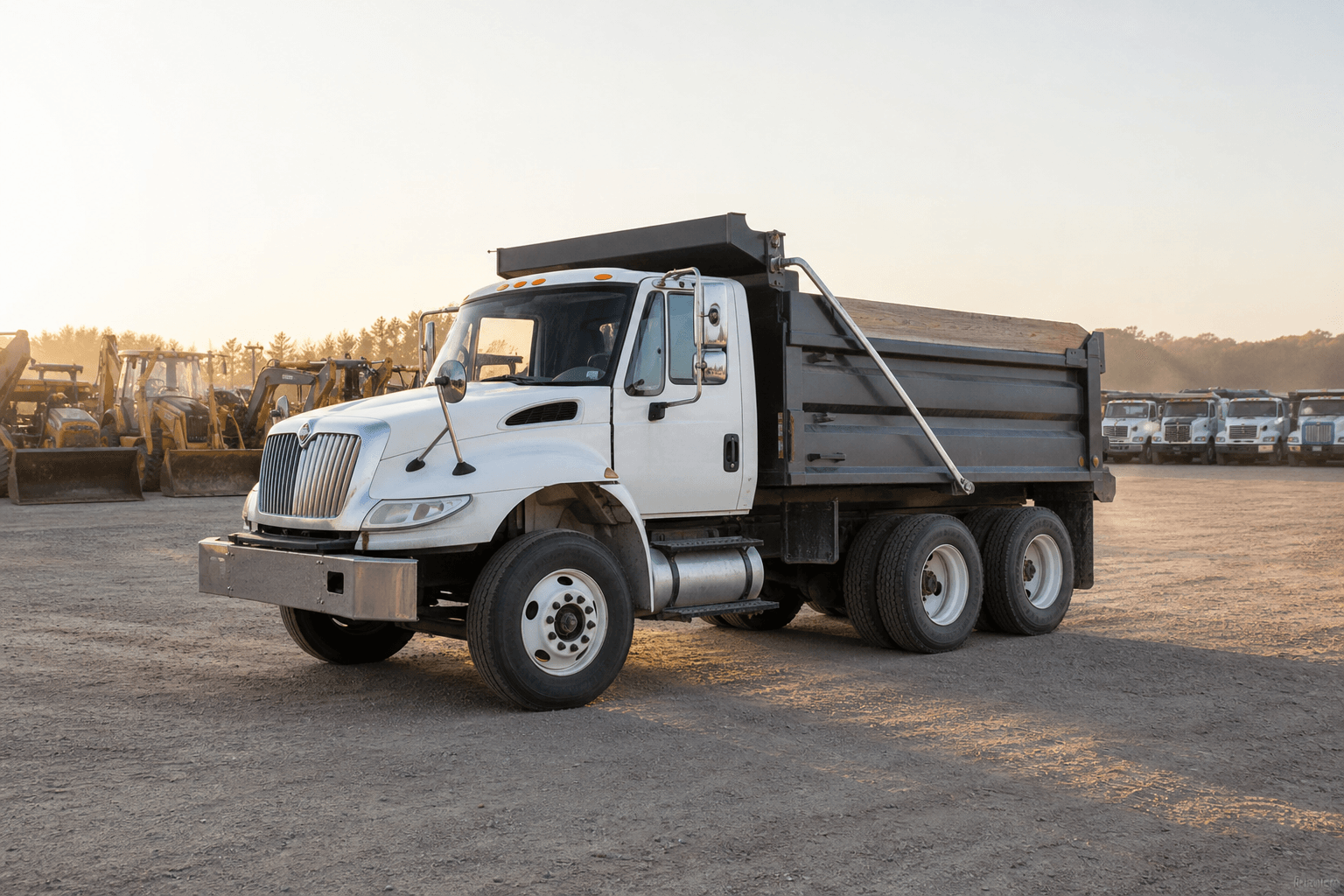
Dump truck rental costs $250 to $600 per day, and renting beats buying only if you need a truck fewer than roughly 40 to 60 days a year. Past that point, an owned used truck usually costs less per working day.
The formula below finds your own break-even number, and it covers the costs on both sides that most comparisons leave out. The figures are ballpark ranges. Dump truck rental rates vary by region, season, and truck age, and used prices swing widely with mileage and condition. Treat them as starting inputs, then swap in quotes from your local rental yard and real listings.
What dump truck rental really costs (daily, weekly, monthly, and the fees nobody mentions)
The headline rate is only part of the bill. Here is roughly what contractors see for a dump truck rental by truck class, before add-ons:
- Single-axle (10 to 12 cubic yards): about $250 to $400 per day, $900 to $1,500 per week.
- Tandem axle (12 to 16 cubic yards): about $350 to $550 per day, $1,200 to $2,000 per week.
- Tri-axle (16 to 20+ cubic yards): about $450 to $700 per day, $1,600 to $2,800 per week.
- Monthly: often $3,500 to $7,500 depending on class, with mileage limits attached.
Then come the line items that turn a $400 day into a $550 day:
- Mileage caps. Many rentals include 100 to 150 miles per day, then charge $1 to $3 per extra mile. A long haul to a dump site can blow through that quickly.
- Delivery and pickup. Heavy trucks usually need a lowboy or a driver to move them. Expect $100 to $400 each way.
- Fuel. You return it full or pay the yard's refueling rate, which is rarely a bargain. A loaded dump truck burns fuel fast.
- Damage waivers and insurance. Rental yards often require coverage or a waiver, commonly 10 to 15 percent of the rental cost.
- Cleaning and wear charges. Return a bed caked with asphalt or clay and you may see a cleaning fee.
One more item deserves its own paragraph: the CDL question. Trucks over 26,000 pounds GVWR generally require a commercial driver's license.
If you or your crew lack one, the rental yard may supply a driver at an hourly rate, or you simply can't legally take the keys. Check the Federal Motor Carrier Safety Administration for current licensing and compliance rules.
Also factor in availability. In spring and summer, rental fleets in busy markets can be booked out. A truck that isn't there when your pour is scheduled costs you more than any daily rate.
What it costs to own a used dump truck beyond the sticker price
Used dump trucks run from under $20,000 for an older single-axle to $80,000 or more for a late-model tandem or tri-axle in good shape. But the purchase price is only the first line. A realistic annual ownership budget looks like this:
- Insurance. Commercial auto and liability for a heavy truck commonly runs $4,000 to $12,000 per year, depending on your location, driving record, and coverage limits.
- Registration, plates, and heavy-vehicle taxes. Varies by state, often $500 to $2,500 per year for a heavy truck, plus federal heavy vehicle use tax on trucks over 55,000 pounds.
- DOT compliance. Annual inspections, a USDOT number if you cross state lines or meet weight thresholds, and recordkeeping. Budget a few hundred dollars plus your time.
- Storage. A secure yard or lot, either your own or rented. Even a modest space can run $100 to $400 per month.
- Maintenance and repairs. Oil, filters, brakes, hydraulics, the hoist, and the bed. A reasonable planning number is $4,000 to $10,000 per year for a used truck, more if it's older or hard-worked.
- Tires. A full set on a tandem can run $3,000 to $6,000. Spread across their life, that's real money every year.
- Fuel. You pay this when renting, too, but it belongs in the per-day math either way.
The cost most people forget is downtime. When your own truck is in the shop, the job doesn't pause. You either pay for a replacement dump truck rental on top of your ownership costs or you lose the day. A truck that's down 10 days a year effectively adds 10 days of rental cost to your ownership side.
Buying also ties up cash, or adds a loan payment. And a used truck keeps some resale value, which offsets part of the cost. A $45,000 truck that sells for $32,000 after three years cost you $13,000 in depreciation, not $45,000.
The break-even formula: how many rental days make buying cheaper?
Here is the whole calculation in plain English. First, find the annual cost of owning:
Annual ownership cost = (purchase price minus expected resale value) divided by years you'll own it, plus insurance, registration, storage, maintenance, and tires for one year.
Then find your all-in cost per rental day:
All-in rental day = daily rate plus delivery and pickup (divided by days per rental), plus waiver, plus any mileage overages and fuel premium.
Finally:
Break-even days = annual ownership cost divided by all-in rental cost per day.
If you need a truck more days per year than the break-even number, buying wins. Fewer, and dump truck rental wins. Driver costs and fuel apply to both sides, so leave them out of the comparison unless the rental yard charges extra for them.
Worked example: a tandem, 60 days a year
Say you're weighing a used tandem at $45,000 that you expect to sell for $30,000 after five years.
- Depreciation: ($45,000 − $30,000) ÷ 5 = $3,000 per year
- Insurance: $6,000
- Registration and compliance: $1,500
- Storage: $200 × 12 = $2,400
- Maintenance and tires: $7,000
Annual ownership cost: $3,000 + $6,000 + $1,500 + $2,400 + $7,000 = $19,900.
Now the rental side. A tandem at $450 per day, plus $150 delivery and pickup spread over a two-day average rental ($75 per day), plus a $50 daily waiver. All-in: about $575 per day.
Break-even: $19,900 ÷ $575 = about 35 days per year.
At 60 days of use, renting would cost $34,500 per year against $19,900 for owning, a gap of roughly $14,600 in favor of buying. At 20 days, renting costs $11,500, well under the cost of owning.
Add the financing interest if you're borrowing, and the break-even climbs a bit. Add downtime days where you must rent a backup, and it climbs again. That's why the honest answer for most contractors lands somewhere between 35 and 60 days.
Plug in your own quotes. If your local yard charges $350 a day, your break-even moves to roughly 45 days. If insurance in your state is $10,000, it moves the other way.
Three contractor profiles: who should rent, who should buy, who should do both
The seasonal landscaper. Hauls mulch, topsoil, and stone from April through June, then a few fall cleanups. Maybe 25 days a year. Dump truck rental wins clearly here. Owning means paying insurance and storage on a truck that sits for nine months. Book your rentals early in spring when fleets tighten.
The steady excavation outfit. Two crews, regular site work, trucks needed 120+ days a year. Buying wins by a wide margin. At that usage, rental costs would exceed $60,000 annually, while ownership might run $20,000 to $25,000. The risk is downtime, so a reliable truck and a good maintenance routine matter more than the lowest purchase price.
The small paving crew. Uses a truck about 50 days a year, with sharp peaks during big jobs. This is the hybrid case. Own one truck for your baseline work, and rent a second for the two or three weeks when a large job needs extra hauling capacity.
You get ownership economics on the days you always need a truck, and rental flexibility for the spikes, without buying a second truck that idles most of the year.
The pattern is simple. The more evenly your truck days spread across the year, the more buying makes sense. The more concentrated and unpredictable they are, the more dump truck rental earns its higher daily rate.
Where used dump trucks come from, and why government surplus is worth a look
Used trucks reach the market through dealers, private sellers, contractor retirements, and public agencies. The last category is easy to overlook and often worth a look.
Cities, counties, townships, and school districts replace dump trucks on a schedule, often by age or hours rather than because they're worn out. Public works fleets typically keep service records, since a municipal truck is maintained under a budget and accountability that a lot of private trucks never see.
A tandem that spent its life hauling salt, gravel, and road millings for a highway department has a documented history you can actually ask about.
Public agencies sell these trucks through online auctions, where the final price is set by bidders rather than a dealer's markup. On Municibid, you can browse current dump trucks from public agencies, along with other heavy duty trucks if you're considering a different configuration. Proceeds go back to the communities that listed them, which is a nice side effect of a smart purchase.
Surplus buying has trade-offs worth knowing. Sales are typically as-is, so inspect the truck in person or send a mechanic when the listing allows it. Read the full description and photos, check mileage and hours, and set your maximum bid ahead of time so auction excitement doesn't set it for you.
Pickup is the buyer's responsibility, so plan how you'll move a heavy truck before you bid. It's one sourcing option among several, not the only one, but for contractors comparing dump truck rental costs against a purchase, it widens the pool of well-documented trucks.
How to decide: a five-question checklist before you rent or buy
- How many days a year will the truck really work? Count from last year's records, not your hopes. Compare that to your break-even number from the formula above.
- Cash or financing? Tying up $40,000 in a truck may cost you other opportunities. Add loan interest to your ownership side if you're borrowing.
- Do you have CDL-qualified drivers? If not, owning a heavy truck isn't just a cost question. You'd need to hire or train, and a dump truck rental with a supplied driver may fit better.
- Where will it live? Secure, legal storage with room to turn a truck around is part of ownership. If you don't have it, price it in.
- How solid is your job pipeline? A truck that's busy 70 days this year but only 25 next year is a different decision than steady work. If your pipeline is uncertain, renting or the hybrid approach lowers your risk.
If your answers point toward buying, or toward adding a second truck for peak season, take a look at what's available. You can browse current dump truck listings on Municibid and compare real prices against your break-even math. If the numbers don't work, rent with confidence, and revisit the question next year when your workload is clearer.